 Subscribe free of charge to Javier's Catholic Website WhatsApp or Telegram channel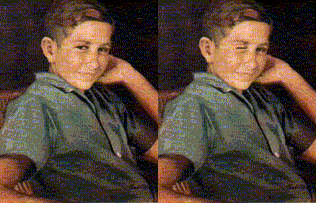
Faustino Pérez-Manglano Magro was born in Valencia on August 4, 1946, the eldest of four siblings. He received from his parents, Faustino and Encarnación, a careful Christian upbringing. In 1952 he entered the Marianist school "Nuestra Señora del Pilar" (at that time located in Plaza del Conde de Carlet). In 1954 he received First Communion, and in 1955 Confirmation. In 1957 he began the second year of secondary school in the new school building located on Paseo de Valencia al Mar (now Avenida de Blasco Ibáñez). His life unfolded like that of an ordinary boy: he loved sports, especially soccer, but also swimming and hiking. He enjoyed movies, television, reading novels, and making friends.
At the age of thirteen he made his first spiritual retreat, a common experience for the students of El Pilar. There he had moments of silence, prayer, and conferences. During this retreat, Faustino told his chaplain, Father José María Salaverri, SM, about the promise he had made: "I promised the Virgin Mary to pray the Rosary every day, especially when I go to school alone." He later wrote: "The greatest effort of my life I made during the retreat, when I tried to change my life completely."
On September 14, 1960, he wrote the first page of his diary. Keeping a diary was an idea that came to him after reading a novel. From then on, he would write regularly, even mentioning the events that marked the day. This diary is a valuable record of his spiritual life and of the events of his life. Its value lies in its spontaneity, since it is the diary of a teenager.
On October 17, 1960, he wrote: "I prayed the Rosary. I received Communion during recess. I had a Natural Sciences exam and I answered well. I spoke for 10 minutes with Christ, about the missions and about the draw between Zaragoza and Valencia." It is in this Diary that the pain announcing his illness is first mentioned (November 14, 1960).
In October 1960, he joined a fraternity of young people from the school. This group met once a week. On October 22 something very important happened to him. During a retreat, after meeting with his chaplain and spiritual director, he wrote that day: "We spoke about many things, but there was one thing that caught my attention: What is my vocation? Doctor, chemist? Perhaps the option of becoming a priest? That last possibility is what has impressed me most. Has God chosen me? He will tell me. In the hours remaining of today’s retreat, I am going to keep complete silence. Perhaps God will speak to me..."
It was also during this retreat that he wrote as a resolution: "I am going to try to live the asceticism of yes: to say yes to everything that is good." Later, when he was asked when he felt the Lord’s call, he would say that that very night, during dinner in silence: "At dinner I saw with complete clarity: the Lord wants me to be a Marianist religious." From that date onward, his friendship with the Lord grew day by day. This close and frequent relationship with Christ became a simple and deep friendship. For him, Jesus was someone close, a friend with whom he could speak about everything, even soccer.
Here are some excerpts from his diary that show that for Faustino, Christ was someone close:
"How wonderful it is to be in the company of Christ" (10/21/1960).
"Help me, Jesus, to be an apostle. I no longer keep anything for myself. May my love for You make me give myself to others" (6/22/1961).
"They brought me Communion. It is wonderful to receive the Body of Christ!" (01/28/1961).
"Christ is here, beside me, in me..." (1/24/1962).
"How good it is to be here, close to Christ!" (1/25/1962).
"I am very happy. Today is the first Friday of May, an important day for me. I felt God’s call as rarely before. United with Mary and Jesus, I was overflowing with joy. How shall I thank God, for how beautiful and wonderful it is to live close to Christ!" (05/04/1962).
"I realize that I must become holy. One cannot be a mediocre Christian. May those who see me be able to see Christ in me" (1/20/1963).
"We must be apostles by our example; our very presence should attract others to Christ" (1/22/1963).
And the joy of living with Christ did not prevent, but rather deepened, his passion for soccer, the mountains, reading, and his friends.
On November 29, 1960, he fell ill. After medical tests, he was eventually diagnosed with Hodgkin’s disease, an incurable illness at that time. He underwent aggressive and exhausting treatment. For long periods, he had to remain at home, but he continued working hard so as not to lose the school year.
He never complained, but in his diary we discover the most difficult moments: "During the afternoon it hurt all the time" (02/06/1961). "At 8 o’clock, I asked Mom to massage me so I could sleep without too much pain. At 10, I woke up, and we went to the Red Cross. They took two X-rays. When we got back home at noon, I felt like crying. I was very bad, very low in spirits." (11/27/1961).
From February onward, he could no longer go to class. But he devoted much time to his schoolwork: he did not want to lose the year. He had to limit all sports, but he did not complain: he was content with what he could do, and he wrote that he was happy and that everything was "wonderful": this was Faustino’s favorite word.
He enjoyed the film-forum sessions held at the school. He saw François Truffaut’s film "The 400 Blows." Even though he could no longer play sports, he stayed close to his classmates when they competed.
In 1961 he went on pilgrimage to Lourdes and spent periods alternating life in the countryside (on doctors’ advice) with the school year. There were months in which he felt better, although the radiotherapy sessions left him tired and physically weakened.
In January 1962, Faustino relates in his diary an anecdote that shows his concern for others: "This boy is fourteen years old. He lives in an attic, can barely eat, and works eight hours a day." He arranges to meet a friend who is in need, in order to help him. This concern for others is an important sign of his character and social sensitivity. His spiritual path did not make him self-centered but rather focused on others: "Being useful to others is one of my resolutions and I want to put it into practice. I will be very attentive to everyone I know and I am going to help them" (6/22/1961).
"We must begin to work to remove from ourselves everything that Christ would not approve of. That means working in my surroundings, at home, at school, with my classmates, in the city, in the whole world" (1/25/1962).
But he spared no effort in living the Christian life one hundred percent: "Today the Church needs witnesses. We must be witnesses of Christ in the twentieth century."
In this process, the Virgin Mary occupied a very important place: "Mary, I want to be your apostle. We must win the world for you, as Father Chaminade did, with you as our guide and Jesus as our model. Help me, Mother, to love you more and better" (05/16/1962).
At the age of 15, he wrote in his diary, dated June 22, 1962: "Today it has been twenty months since God told me to follow Him. It is wonderful to think that I will be all my life at the service of Jesus and Mary. I will be a fisher of souls. I have been reflecting and I would like to go as a Marianist religious to South America, where so many hands are needed to save souls."
Faustino remained faithful: he did not forget the decision made twenty months earlier. In the summer of 1962, he took part in the school camping trip through France and Switzerland. On January 23, 1963, he wrote: "I have to be a true Christian. To achieve this, I have to slowly smooth away my imperfections, because being a good Christian is not easy. It is even more difficult than one imagines. Mary, help me to be another Christ."
On January 23, 1963, he did not get out of bed. He would never recover. He did not respond to treatment. The doctors were helpless and knew that there was no hope of recovery. On February 11, 1963, he wrote: "The day before yesterday, Saturday, was a very happy day for me, because I received the sacrament of the sick and renewed my promises for one month as a member of the Fraternity. Today is the feast of Our Lady of Lourdes. May our wonderful Mother in Heaven help us all to become better. Help me, Mother, to offer these small discomforts for the good of the world."
Three days before his death, his spiritual director visited him; he seemed to be suffering greatly.
"How are you, Faustino?"
– "Fine, Father."
– "Are you in pain?"
– "That depends on your point of view."
"How so?"
– "Well, let’s see, Father, at this moment there are many people suffering more than I am!"
Faustino showed great self-mastery. Not a single word of complaint was heard from him.
On the afternoon of March 3, 1963, his chaplain, Father José María Salaverri, came to see Faustino, who seemed to be suffering a great deal. But in the middle of the conversation, he still asked:
"Father, do you know whether tonight’s match is going to be on television? But how silly I am: I will not be able to follow it! I’m very tired!"
On the bedside table there was a paper on which one could read the line-up of the match. That same night, late, he called his mother. As he tried to straighten his aching body, he suddenly collapsed, without a gesture, in silence, gently, and remained unconscious in his mother’s arms. Thus he passed into the arms of God our Father. It was 11:20 p.m.
His biography, "Perhaps God Will Speak to Me," written by Fr. José María Salaverri, has been translated into Italian, French, English, Hungarian, Polish, German, Portuguese, Japanese, Ukrainian, and Korean. There are shorter biographies by various authors written in Papiamento, Rwandan, Swedish, and Albanian. The book on favors granted through Faustino, called "Faustino’s Loaves and Fishes," is also available in Polish. Another work by Father José María Salaverri, "Faustino’s Four Yeses," has been published, among other languages, in Kinyarwanda, the national language of Rwanda. For her part, the Swedish writer Katarina Johanson published in her country another children’s book on Faustino’s life.
Dozens of youth movements have arisen in different countries of the world inspired by Faustino.
Father José María Salaverri SM, Faustino’s teacher and spiritual director, his biographer and principal promoter of the cause from Valencia to Rome, wrote: "Venerable." What does this mean? The word "venerable" fills us with reverence. We usually apply it to people with gray hair, elderly people, "venerable" because of the wisdom acquired over so many years of healthy life experience... But can a boy of sixteen and a half really be called "Venerable"?
Pope Benedict XVI approved Faustino’s heroic virtues on January 14, 2011. Previously a group of nine theologians had studied his writings and the many testimonies about him. Their unanimous conclusion was: "Faustino practiced the Christian virtues in a heroic manner." Put into everyday language, they were telling us that Faustino deserved the highest honors in Christian life. And all this without ceasing to be a young man who loved soccer, swimming, hiking, and sports.
Joyful and enthusiastic, at the age of 14 he came up with the idea of "saying yes to everything good," to what is human and to what is divine. A friend to his friends and a friend of Christ and Mary, who were—as much as those others—a constant presence in his life. His classmates said he was very helpful. So much so that he felt called by Christ to become a Marianist and a missionary. He could not, since Hodgkin’s disease ended his life on March 3, 1963. But he lived his life always smiling. "He was all smiles," someone said about him.
Later, Pope Benedict XVI confirmed for us that Faustino knew how to live with common sense and naturalness, and also with the gift of wisdom from the Holy Spirit. And therefore, we can call him "Venerable."
It all began after his death. Archbishop Marcelino Olaechea of Valencia read a brief account with features of Faustino’s life, testimonies, excerpts from his diary... He was enthusiastic and, as a good Salesian educator, said: "Here we have a new Saint Dominic Savio!"
Saint Dominic Savio was the young disciple of Saint John Bosco.
Archbishop Marcelino Olaechea approved a prayer to ask for favors through Faustino’s intercession. But, because of a series of circumstances, the Cause was slow to begin officially. One reason was the discussion among theologians about the possible canonizable holiness of children and young people. Paul VI appointed a commission of experts to study the question. They completed their study already under the pontificate of Saint John Paul II. The conclusion was clear: the Second Vatican Council had declared that holiness must be the goal of every baptized person. Children and adolescents who die prematurely can also attain official holiness, if they have loved God and neighbor in an outstanding way, according to their age, in their own manner, and in their circumstances.
Archbishop Miguel Roca Cabanellas of Valencia was enthusiastic when he was asked to begin the diocesan process for beatification. He confessed that reading Faustino’s life had moved him to tears as it reminded him of some episode from his own youth.
He requested that Faustino’s remains be transferred to the chapel of El Pilar School in Valencia and wished to preside personally over the ceremony on April 11, 1986. On October 17 of that year, he himself presided over the opening of the process. With this, Faustino gained his first official title: "Servant of God."
For four years, witnesses came forward to testify before the diocesan tribunal: family members, teachers, classmates, and people who had known him. All his writings were collected. Two theological studies were carried out... And on December 14, once again Archbishop Roca presided over the closing ceremony. Several packets containing all the information received were sealed and everything was sent to the Vatican’s Congregation for the Causes of Saints.
Father Enrique Torres, postulant of the Marianist causes, under the direction of Archbishop Gutiérrez, studied all the documentation to determine whether it could truly be a case of authentic canonizable holiness.
With all those studies and documentation, a volume of more than 700 pages was printed, called the Positio. In 2009, nine theologians gave their opinion in writing. A commission of cardinals and bishops, whose rapporteur was Archbishop Edmund Farah, an Eastern Maronite archbishop, again studied the entire process and gave its approval, which was ratified by Pope Benedict XVI. On January 14, 2011, His Holiness Benedict XVI recognized the "heroic virtues" of Faustino Pérez-Manglano, declaring him Venerable.
Subscribe free of charge to Javier's Catholic Website WhatsApp or Telegram channel
Last updated: March 14, 2026.